
Thailand vs the Philippines for retirement — SRRV visa, cost of living, healthcare and air quality across 7 factors
In one line
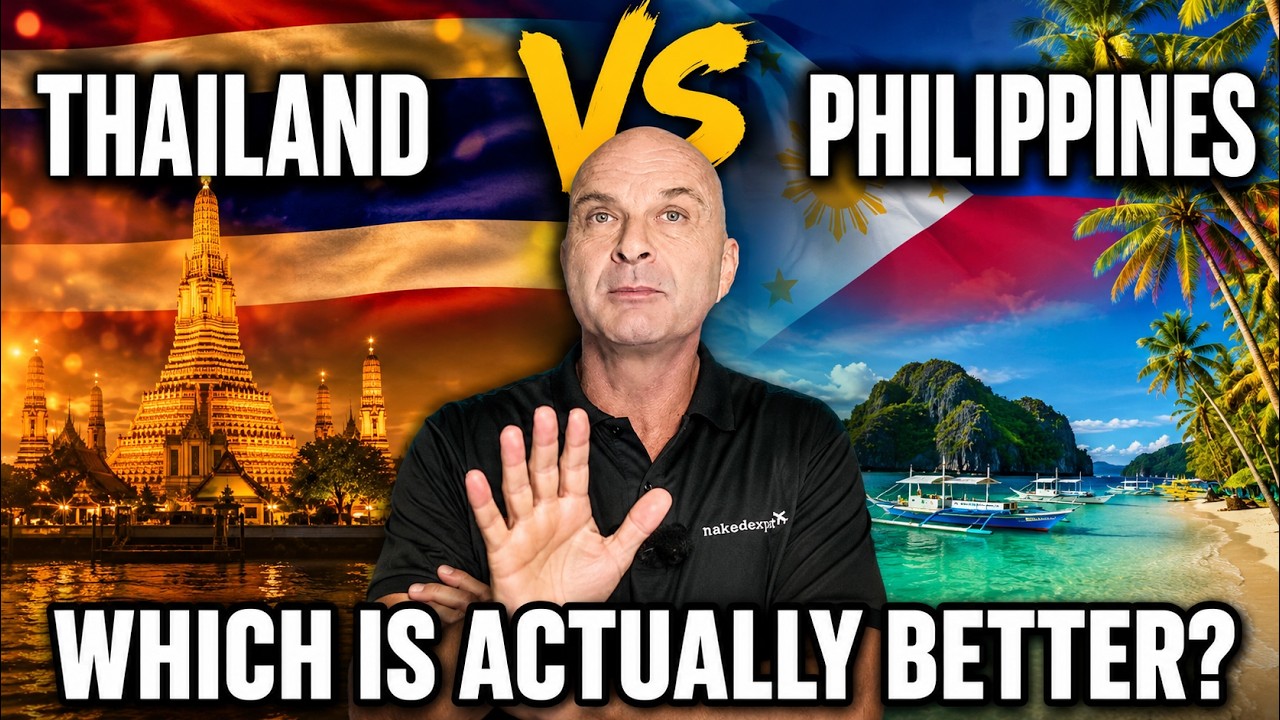
A host who has lived in both countries scores Thailand and the Philippines on seven factors: cost of living, visas, healthcare, climate, social life, relationships and culture. His point is that the real question isn't which country is better, but which one fits you.
💡 Key takeaways
[Cost of living]
• A comfortable mid-market life in the Philippines, in a good location with good housing, costs about $1,400–2,200 a month. Chiang Mai costs about $1,500–2,500, and he puts Bangkok at about $2,500–4,000.
• Manila is pricier than many expect, especially Makati and Bonifacio, where many expats live. Clark and Angeles offer slightly better value with solid infrastructure, and Cebu sits in between. The provinces are cheapest but come with trade-offs.
• Both the peso and the baht move with exchange rates, so your real purchasing power changes. He recommends having your retirement finances checked for currency risk.
• Host's score: Thailand 8, Philippines 7.5.
[Visas and property]
• The Philippine SRRV (Special Resident Retiree's Visa) is mainly for people over 50. It gives indefinite stay and multiple entry, and the visa itself has no annual renewal.
• The SRRV ID card still needs a fee to stay current, paid every year or two years at once. He calls it an admin task like renewing a driving licence, not a residency review.
• The Thai retirement visa (OA) must be renewed every year, and in his view its financial-proof requirements have grown stricter.
• In both countries, foreigners cannot own land. Condos can be owned, but foreign ownership in a building is capped at 40%. He says renting is often better than buying.
• Host's score: Philippines 8, Thailand 6.5.
[Healthcare]
• The Philippines has good private hospitals in Manila and Cebu, and to a degree in Davao. Examples include Makati Medical Center, St. Luke's Medical Center in Bonifacio and The Medical City.
• Outside the big cities, provincial hospitals have limits for complex acute care. Plan for medical evacuation too.
• He rates Bangkok's private care (Bumrungrad and others) a level above the top Philippine hospitals, though the gap is not dramatic.
• Neither country is a place to live without international health insurance. Arrange it before you move.
• Host's score: Thailand 9, Philippines 7.5.
[Climate and air quality]
• The Philippines is hot and humid all year. The wet season varies by region but runs roughly May to October, and the dry season November to April.
• The country sits in a typhoon belt. The eastern seaboard is more exposed than the west, so if in doubt, choose the west.
• Citing the IQAir 2025 report, he gives average PM2.5 levels of about 19.0 µg/m³ for the Philippines and about 17.8 for Thailand. Both are far above the WHO guideline of 5.
• He says about 80% of Philippine air pollution comes from motor vehicles, such as jeepneys and old trucks, and that Manila's air is worse than Bangkok's. If you're considering Makati or Bonifacio, factor in air quality.
• Away from the cities, on the islands, along the coast and in rural areas, the air is much cleaner. He especially praises the scenery in Palawan, Siargao and the Visayas.
• Chiang Mai's air gets very bad in the March–May burning season, and many long-term residents leave during that time.
• Host's score: 7 each.
[Social life, relationships and culture]
• The Philippine expat community is centred on Cebu, Manila, Angeles and Clark. English is an official language, so mixing with locals is much easier. Thailand's expat scene is bigger and more international, but the language barrier is real (social life: 8 each).
• For men seeking a genuine long-term partner, he thinks the Philippines is easier because of the language and its family-oriented culture (Philippines 8.5, Thailand 7).
• On culture, he says Thailand leads on depth and aesthetics, while the Philippines leads on human warmth and the bayanihan spirit of helping each other. To thrive in the Philippines, you need to take the traffic, the bureaucracy and the gaps in provincial infrastructure with good humour (Thailand 8, Philippines 7.5).
[How to choose]
• Choose the Philippines if long-term residency security (the SRRV), English in daily life and relationships, and human warmth matter most to you.
• Choose Thailand if you want top-tier healthcare, a diverse expat scene and deep culture, and you don't mind renewing your visa every year.
• If you're torn, spend three to four weeks in each place living like a resident, not a tourist.
• Wherever you go, your will, power of attorney and asset structure must be set up for that specific country, because tax and property rules differ.
• This week's task: write down your top three priorities and map them against the seven factors.
⏱ Chapters
05:08 Cost of living compared
08:12 Visas and property ownership rules
12:15 Healthcare, hospitals and insurance
15:18 Climate, typhoons and air quality
21:22 Social life and expat community
23:24 Relationships and dating
29:36 Choosing the country that fits you
31:39 Legal and financial groundwork, next steps
💬 What viewers said (149 comments)
• Many commenters chose the Philippines for the visa and English. A view that Thai healthcare is far better, including from a former health professional, also drew agreement.
• A long-term Thailand resident pushed back on the video, saying the O visa can be extended every year (about $58) and its financial requirements have not changed in over a decade.
• In the comments, the channel owner added points on tax residency, the UK pension uprating issue and Philippine beaches such as La Union and Ilocos. One viewer asked for a video on health insurance costs.
In my opinion the Philippines has a much easier and better visa option, and English is a big plus, but it has plenty of negatives too.
I'd like to see a video on health insurance costs by age and what they cover.
Fair on cost of living and currency risk. But you missed Thailand's O visa, which most retirees use. It has similar financial requirements to the OA but doesn't require health insurance. Those requirements haven't changed in over a decade. You extend it each year for about $58 and can stay indefinitely. Many Philippine retirees use repeated tourist entries, which is less stable than the SRRV. Visa runs no longer work in Thailand. You can also find normal relationships in Thailand if you avoid the entertainment venues.


Comments 0
Please log into write a comment.