
Hospital Costs and PhilHealth in the Philippines — The Healthcare Reality Expats Learn Too Late
In one line
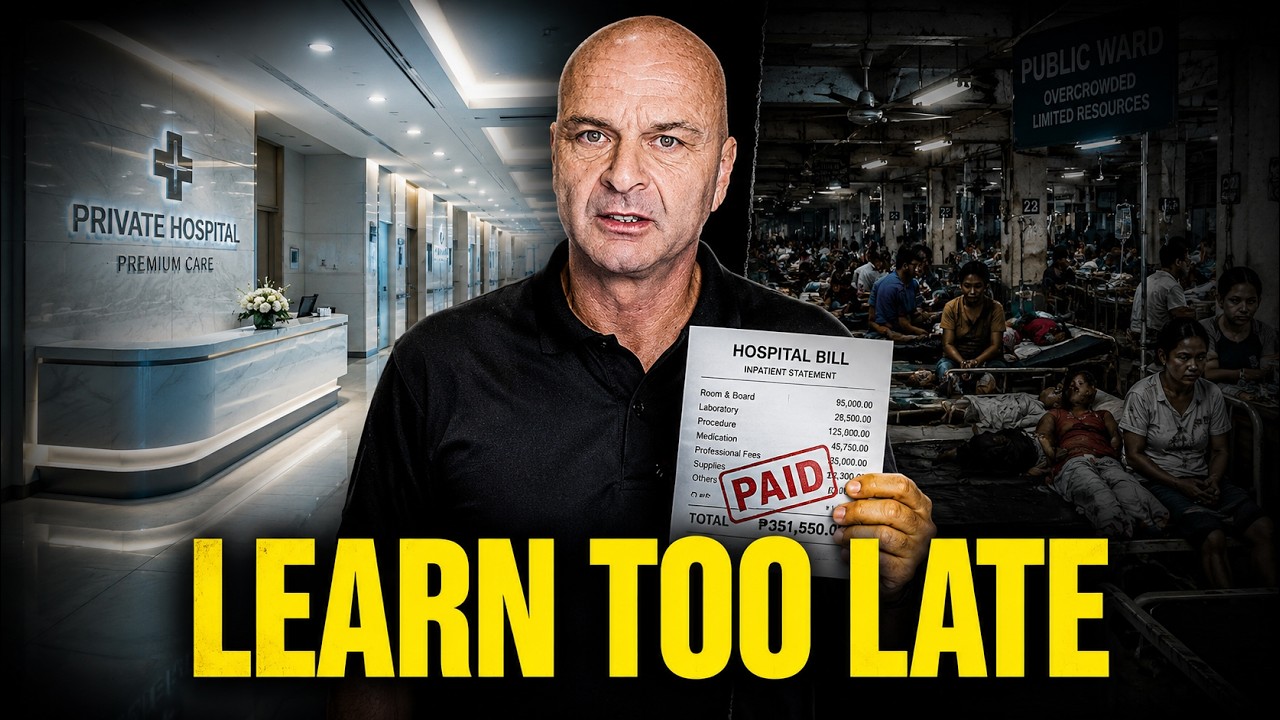
Philippine healthcare is split between big-city private hospitals and public hospitals. PhilHealth is cheap but covers little, so the host advises checking how far you are from a hospital and getting international health insurance that includes medical evacuation.
💡 Key takeaways
[Two-tier healthcare]
• Private hospitals in Manila, Cebu and big cities like Angeles and Clark are said to have good facilities, specialists and English-speaking staff.
• Public hospitals are crowded with long waits and few specialists. In the host's view they're fine for routine care but best avoided for serious cases.
[The distance problem]
• A case the host heard about: a British expat in his mid-60s living in a provincial coastal town had a heart attack. The local hospital couldn't handle it, so he was moved to a private hospital 2 hours away. He survived, but with no insurance the bill came to several years of his pension.
• Before choosing where to live, check: the nearest hospital with real cardiac and trauma emergency capability, the realistic travel time given traffic and time of day, and whether air ambulance or medical evacuation is available.
[PhilHealth]
• Long-stay foreigners with an ACR I-Card can join. Per the host, it's about 15,000 pesos a year, or about 12,000 pesos for SRRV (retiree visa) holders (commenters say it has since gone up).
• It cuts hospital bills by up to about 30%, but only in a shared ward. In a private room the coverage is close to nothing, he says.
• If your Filipina spouse has PhilHealth, you can reportedly be added for about 500 pesos a month.
• The host calls it "cheap and worth having, but a small buffer that's nowhere near enough on its own."
[Real costs]
• A heart condition, major accident or surgery at a good private hospital can cost hundreds of thousands of pesos even in a simple case, and millions in complex ones.
• Medical evacuation from the provinces to a big hospital or abroad can cost tens of thousands of pounds or dollars on its own, he says.
[Choosing insurance — host's view]
• He recommends international health insurance with private hospital cover and medical evacuation included as standard.
• He prefers pooled-premium policies, which spread risk across all policyholders, over individually claims-based policies whose premiums jump after a claim, and advises choosing an insurer overseen by an ombudsman who can step in on claim disputes.
• He urges reading the small print on local or Asian policies and most US, EU and Australian ones. He introduces international insurance adviser Alex Routh.
⏱ Chapters
00:00 A heart attack two hours from help
03:09 Private vs public: two-tier healthcare
05:12 The distance problem and where to live
06:14 What PhilHealth actually covers
08:17 The real cost of going uninsured
10:20 What to look for in international insurance
13:23 What to do this week
💬 What viewers said (64 comments)
• The most-liked comment was a stent procedure at Chong Hua Hospital in Cebu — 4 days in a private room for about 600K pesos paid by card — which sparked a debate on self-funding versus insurance.
• Others shared ICU costs of about 70K pesos a day in Dumaguete, deposits demanded on admission, and hospitals not releasing patients until the bill is paid.
• Viewers pointed out that foreigners don't get the senior discount, argued that PhilHealth fees have already risen, and raised the problem of being too old to get insured.
I just had a stent put in at Chong Hua Hospital in Cebu City. I spent 4 days in a private room. The total cost was 600K pesos, no insurance, paid with my credit card. The money I saved by not paying for Medicare Part B for 5 years paid for my treatment. I feel great now. The hospital, doctors and nurses were all great and I would do it again if needed.
I am 79 and cannot get any insurance because of my age. Any suggestions?
I stopped listening after hearing the PhilHealth costs. You're out of date — it's P17K for tourists and P15K for SRRV holders. I'd assume what you say about coverage is also out of date, since the rules keep changing.


Comments 0
Please log into write a comment.