
The Philippine barangay system explained — the British expat who went to the police first and nearly got deported, plus clearances and the blotter
A British YouTuber who has lived in the Philippines for over 13 years explains the barangay system every foreign resident should know, and the mistakes to avoid.
💡 Key takeaways
[Opening story — as told by the host]
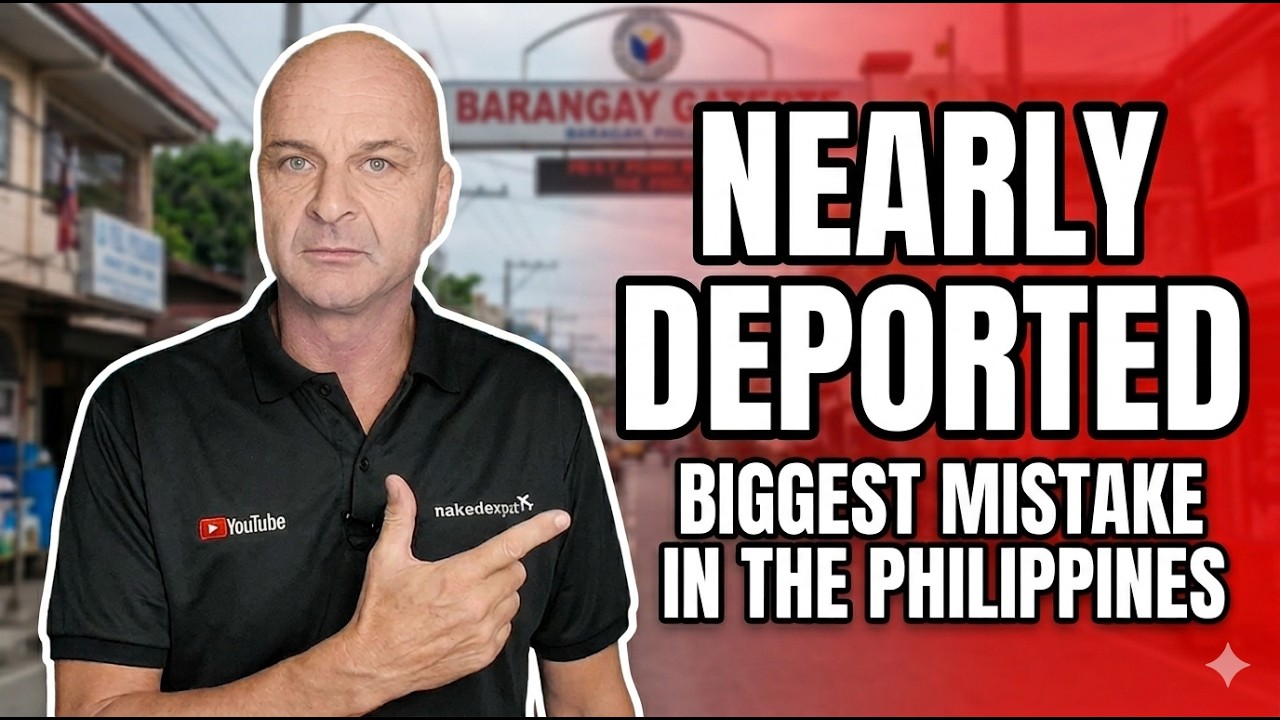
• A retired Brit in his mid-50s, about 4 months after moving in, had a neighbor playing loud music at midnight to 1 a.m. He skipped the barangay and went straight to the police station.
• The neighbor's family knew the barangay captain. Within about 2 weeks there was a blotter (complaint record) entry against him, and about 6 weeks later it was cited in a report to the Bureau of Immigration.
• He avoided deportation but had to leave the area and start over, at the cost of months of stress and significant legal fees.
[What a barangay is]
• The smallest administrative unit in the Philippines; there are roughly 42,000+ nationwide, and wherever you live you are in one.
• It is headed by an elected barangay captain (punong barangay), with a barangay council below and the tanod, a volunteer neighborhood watch.
• Under the Katarungang Pambarangay (barangay justice system), most civil disputes and minor criminal matters between residents of the same barangay must go through barangay mediation before reaching a court — including disputes with landlords, neighbors, a partner's family, and noise complaints.
[Barangay clearance]
• Certifies you are a resident in good standing. Used for employment, some business registrations, some bank accounts, and as a supporting document for visa/immigration processes; some landlords require it before signing.
• Go to the barangay hall in person, show ID, pay a small fee; usually issued within a day.
• Negative blotter entries or unresolved disputes can get it withheld or delayed, so keep your record clean.
[Certificate of Residency]
• A separate document confirming your registered address in the barangay.
• May be requested by banks, the Bureau of Immigration for long-term visa holders, and for registrations such as PhilHealth. Also issued at the barangay hall.
[The blotter]
• Every complaint, incident and dispute is recorded with names, dates, nature and outcome. Being named in it is common.
• But complaints against you for disturbance, threats or disrespect can be referenced later; the host says immigration can request barangay records and a pattern of complaints can become a visa renewal problem.
• If you are the victim of harassment, a scam or threats, a blotter entry becomes an official record in your favor.
[When a dispute happens]
• Taking an everyday dispute with a neighbor straight to the national police (PNP) without the barangay is read as disrespecting the local system.
• Go to the hall, explain calmly and respectfully to the captain or a council member, and let mediation work.
• Outcomes often favor community harmony and face-saving over strict legal rights, so humility works better than arguing to win.
• For something more serious, file a blotter entry at the barangay first, then take it to the police.
[The host's 5 steps]
• 1) Know where your barangay hall is, the captain's name and the opening hours.
• 2) Go in person, dressed neatly, with a modest gift (donuts, local food — nothing that looks like a bribe), introduce yourself and ask what a foreign resident should know. It's not too late even after 2 years.
• 3) Some barangays keep their own records of foreign residents separate from immigration — ask whether you should register.
• 4) Engage occasionally: attend an event, contribute modestly to a local project.
• 5) Disputes go to the barangay first; if you're a victim, blotter first.
• If you haven't arrived yet, he recommends making the introduction within your first 2 weeks.
[Common mistakes]
• Assuming local rules don't apply to foreigners, putting off the introduction for months, expecting Western legal logic, and leaving a conflict with the captain to fester. Give the captain a way to resolve things without losing face.
⏱ Chapters
00:00 The expat who nearly got deported
02:07 What a barangay is
05:08 Five areas of your life · barangay clearance
06:10 How disputes are actually resolved
08:13 Certificate of residency · relationship with the captain
11:18 The blotter
12:18 Common expat mistakes
16:23 Five concrete steps
💬 What viewers said (200 comments)
• Several viewers shared experiences of settling a car accident or a used-motorcycle dispute smoothly through the barangay.
• Many agreed with building the relationship early — one's father-in-law was a former captain, another lives next to the barangay secretary and has helped with events for years.
• Some pushed back that in large Metro Manila barangays the captain is hard to reach and introducing yourself is not a legal requirement.
• The host replied that the Clark Freeport has no barangay and is policed by the CDC, and that you should try resolving things with a neighbor only twice before going to the barangay.
I'm a 59-year-old German living in a small town in Eastern Samar for two years. I had a problem buying a used motorcycle from another expat's Filipina wife, who tried to trick me. My girlfriend introduced me to the barangay captain, then to the police chief, who came with me to the barangay hearing. I got my money back. A positive experience — though my girlfriend being well respected in town probably helped.
The Philippines is still tribal at heart; a barangay captain is like a tribal chief. I've never dealt with the barangay — my girlfriend's family handles disputes, and in my gated subdivision the HOA enforces the rules.
Have you already introduced yourself to your barangay captain? Drop your city or municipality below — and tell me honestly: did anyone warn you about this before you arrived?


Comments 0
Please log into write a comment.