
Clark: Past, Present and Future — Walking the Former US Air Base and the Airport & Railway Projects
In one line
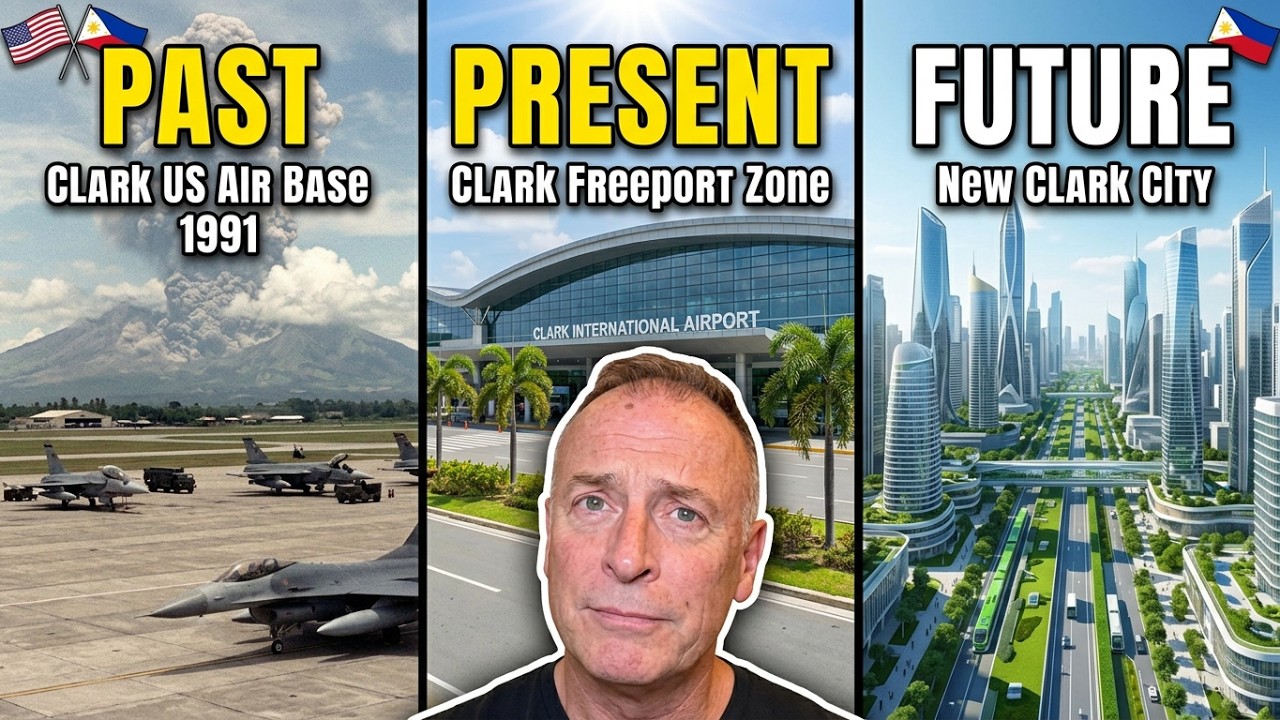
A Clark-based host recaps the history of the former US air base (the Pinatubo eruption and base closure), walks the surviving buildings, parks and cemetery, and visits the airport and railway construction while introducing future development plans. The host notes he never served at Clark and gathered the information through research and conversations.
💡 Key takeaways
[History of Clark]
• It began around 1902–1903 as "Fort Stotsenburg" and was later renamed Clark after Major Harold Clark, a US Army aviator. During the base era it was the largest US Air Force base overseas, he says.
• It is about 90–95 km from Manila and about 70 km from Subic.
• Mount Pinatubo erupted on June 15, 1991. Combined with a typhoon, wet ash collapsed roofs and lahars (mudflows) followed; 847 people died and more than 200,000 lost their homes.
• In September that year the Philippine Senate rejected extending the US base leases, and the base closed almost immediately. About 42,000 Filipinos were directly employed by the base, he says.
• After the eruption, remote base houses were heavily looted — wiring, plumbing and even toilets were stripped. Today some base housing is used by the Philippine Air Force, while other houses were demolished or rebuilt.
[Places to see now]
• Parade Grounds track: very crowded with families on Sundays, so the host doesn't recommend going then. In the evening the trees are lit up, and it's a nice walk on cooler nights.
• Barn Houses: the first quarters built on the base around 1902–1903, now all restaurants and cafes. They were built with imported Oregon pine, and most of the acacia trees around them are said to be over 120 years old.
• Chambers Hall: bachelor officers' quarters → Holiday Inn → now "Quest Plus Conference Center." The host often goes for the breakfast buffet (about 1,050 pesos) and recommends it as a decent mid-range hotel in Clark.
• Manuel Roxas Highway (formerly O'Leary Avenue) is the main street, with the old base gas station, the former hospital site, and Filfest Mimosa Leisure City (condos, retail, restaurants and the old base golf course driving range).
• Swiss Hotel, Fahan and Marriott are connected, with shops and restaurants inside, including a Hard Rock Cafe.
• The area around the remains of Kelly Theater is the Philippine Air Force side, with a guard posted, so it's best not to get too close.
• New picnic area next to the horse-riding area on the way to the airport: small amphitheater, walking/biking path, restroom, plenty of parking and benches. The host says it's one of the few quiet places to sit in Angeles.
• The salakot ("Asian hat") structure was dismantled when the base was handed over and reassembled at Astro Park.
[Clark Veterans Cemetery]
• Along with Corozal Cemetery in Panama City, it's said to be one of only two places outside the US still accepting burials of eligible US veterans.
• About 20 acres and about 9,000 graves; many Philippine Scouts are buried here.
• After the base closed, the local VFW post looked after it; since 2013 the American Battle Monuments Commission (ABMC) maintains it. The host recommends a visit if you're in Clark or Angeles.
[Hospital, airport and railway]
• The Medical City Clark: right in front of the airport, about 103 beds, an emergency room, and serves as the airport trauma center. It's one of the hospitals in the Angeles area that accept US military TriCare insurance.
• The old base airport terminal closed in 2022, and the new terminal opened on the other side in 2022 (capacity about 8 million passengers a year).
• On his trip to Singapore last week the host found no lines at check-in, immigration or security, and says Clark is much easier than NAIA.
• An underground train station and a covered walkway are being built in front of the airport; once done, Clark Airport to Makati is expected to take about 45 minutes, he says.
• Completion dates vary even within the host's own account — around 2027–2028 for the airport station area and 2030–2032 for the whole line — and he expects more delays.
• The new terminal next to the SM Clark car park looks set to be a multi-purpose terminal for buses, taxis and jeepneys.
[Around the main gate]
• The main gate has been moved. Clark City Front Mall (part of the Clark Freeport Zone) is on the right and SM Clark on the left; the SM site was the old visitor center, he says.
• Below the gate are Fields Avenue and the jeepney terminal, and beyond that Walking Street, now called "Red Street." The host thinks this jeepney stop may later move to the railway terminal.
[Future plans — according to the host]
• According to the host, about 150,000 Filipinos currently work in the Clark Freeport Zone.
• Under the US-led "Pax Silica" initiative, an AI and semiconductor center is planned on land near New Clark City, expected to bring at least 160,000 direct jobs and 700,000–900,000 indirect jobs, with construction starting around 2028–2029. The host says it isn't finalized yet.
• The host says the nightlife district is only 4–5 blocks, and Clark has green spaces, biking, running, horse riding, water parks, restaurants and an international airport — worth considering if you're still deciding where to live in the Philippines.
⏱ Chapters
00:00 Introduction to Clark and future plans
06:16 Pinatubo eruption and base closure
09:32 Parade Grounds, Barn Houses, Chambers Hall
14:15 Former base facility sites and theaters
17:31 New park and base housing
20:30 US veterans cemetery
23:49 Hospital, airport and railway construction
28:40 Main gate area and wrap-up
💬 What viewers said (45 comments)
• Many comments are memories from US military veterans who served at Clark and Subic during the base era.
• Viewers corrected or added to the video — e.g., Chambers Hall also served as officer and visitor lodging, and the Four Seasons building was a hardware/sporting goods/motorcycle store rather than a restaurant.
• There was news of a bill allowing the sale of land and houses on former US bases, and a back-and-forth between the host and a viewer over where the acacia trees came from.
Thanks for the extra insight. Kokomos is still there — not sure about the original location, but it's still very popular. The others you mention are gone.
Those acacia trees are plentiful across the Philippines — Visayas, Luzon and Mindanao, not just Clark. The claim that Americans brought them from Africa isn't true; there are many distinct species of acacia.
One of the best videos I've seen about the Philippines! My wife and I love Clark. Too bad there aren't more residential homes there — we'd move in a minute.


Comments 0
Please log into write a comment.