
Two years of running an Airbnb in a Cebu IT Park condo — revenue, net profit, condo-investment views and hands-on upkeep
In one line
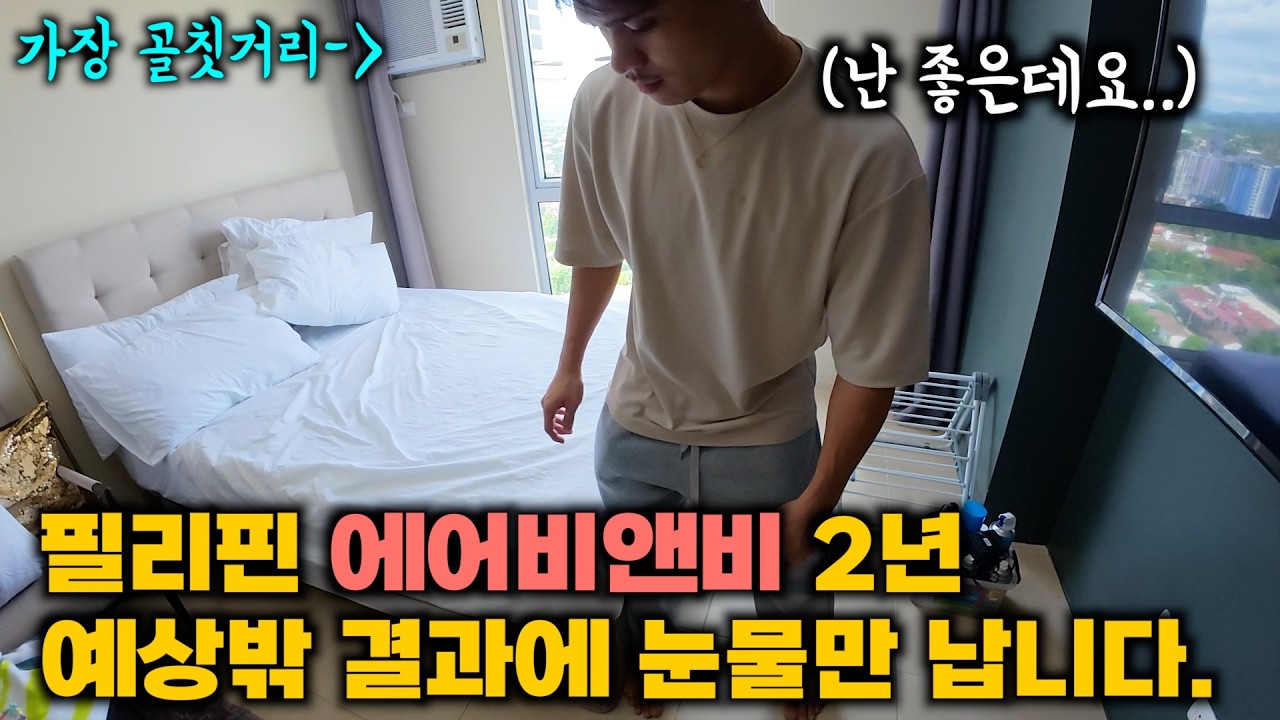
A Korean dad who has run an Airbnb in a Cebu City IT Park condo for over two years shares his revenue and net profit (his own estimate) and his view on investing in Cebu condos. He also handles upkeep himself, such as cleaning the air conditioner and removing limescale from the toilet.
💡 Key takeaways
[Results — as stated by the host; auto-captions, so figures are approximate]
• He has been a Superhost for over two years, and he says occupancy is about 80% or more each month.
• Airbnb changes the rate automatically for high and low season. He says the host can set a minimum, but there is no maximum.
• Last summer's peak season brought in about 2 million won a month. He says it was brief, and since then it has been about 1.2–1.3 million won, dropping to about 900,000 won in slow months.
• After electricity, water and other costs, he estimates net profit at about 1 million won a month. He thinks he can recoup his investment within 10 years.
• He says quite a few people in Cebu run several Airbnbs. Many Koreans clean the units themselves, and many others hire Filipino staff.
[Investing in Cebu condos — host's opinion]
• He doesn't really recommend condo investment because there is effectively an oversupply. He adds that units are hard to sell.
• Places like IT Park have malls, franchise restaurants and a night market all in one place, so tourists and business travelers book well. He says this holds even though the condo quality is low by Korean standards.
• He sees isolated condos with no infrastructure nearby as a poor investment, even though they cost a bit less.
[Upkeep pitfalls]
• He says most condo materials are cheap Chinese imports. His window-frame handle keeps working loose no matter how often he fixes it, and the hallway handles have already fallen off.
• He hired a cleaning company to clean the air conditioner, but they did a sloppy job and black dust came out. So he cleaned it himself with foam cleaner and an air compressor.
• He says pressing the off button makes the fan run automatically to dry out moisture inside.
• He believes the unit's Samsung air conditioner is an OEM product made by a Chinese company.
• Limescale built up on the toilet tank parts, so water kept leaking. Guests didn't notice, the water bill ran high, and the condo contacted him. He says even a new part doesn't last a month.
[Other]
• On the way, he saw a fire in a squatter area of Cebu City. He says the houses are wooden, so once one catches fire, dozens or more burn.
• Cebu Country Club, an old golf course, sits in the middle of Cebu City.
• He also stopped by the Korean consulate that day.
⏱ Chapters
00:01 Heading to Cebu City, gear brought along
02:06 Broken window handle and Chinese materials
03:07 Airbnb update — revenue and net profit
05:09 Views on Cebu condo investment, IT Park location
06:11 Cleaning the air conditioner
08:15 Cleaning the air conditioner fan
09:17 Squatter-area fire
10:47 Removing limescale from the toilet
💬 What viewers said (200 comments)
• The most common tip was to dissolve limescale with citric acid or vinegar. Others suggested fixing the window handle with rivets.
• A debate broke out over whether 1 million won net is realistic. One viewer estimated a studio nets only 20,000–30,000 pesos after costs. The owner replied that electricity runs 1,100–2,100 pesos and that he set the daily rate to 2,000 pesos or more.
• The owner said he paid over 100 million won at pre-sale, but resale units now go for 80 million. He advised buying from individual sellers rather than pre-selling developers.
• Many viewers marveled at how he fixes everything himself, calling him 'MacGyver'.
Pinay dad could live without YouTube, just quietly making and fixing things, and still never go hungry.
How did you handle cleaning and management of the Airbnb while you were in Korea?
Citric acid is best for limescale — it's more acidic than vinegar. When it's this bad, dilute it with a little water and it disappears quickly.
I'm doubtful about 1 million won net. This looks like an Avida studio. To make that, you'd need at least 2,000 pesos a night at 80% occupancy, and then subtract electricity, dues, water, cleaning, laundry and other costs. A studio rarely gets 2,000 a night — realistically 1,300–1,500, so about 17,000–20,000 pesos a month. You'd do better putting 100 million in a bank.


Comments 0
Please log into write a comment.