
PhilHealth
Writing this at the request of D.j. DuLong (and others). Please understand that everything here is based on what I have researched and personally experienced in Cebu City over the past four and a half years. Your experience may differ. I also have 30 years of experience in healthcare, so my view of PhilHealth and medicine comes from a fairly informed place (though through an American lens). I'm not interested in arguing with anyone or defending what I say. Likewise, I encourage everyone to look into this themselves! Don't rely only on Facebook groups or YouTube videos. I hope that if even one or two of you find something useful here, it will have been worth it.
Many people think of PhilHealth as nothing more than a "discount card" that might cut a bill by up to 20%. There is some truth to that. It can significantly reduce a bill, often by as much as 100%. There is also the recently expanded large outpatient benefit (YAKAP), which, used well, can pay for itself on its own.
Let's look at both.
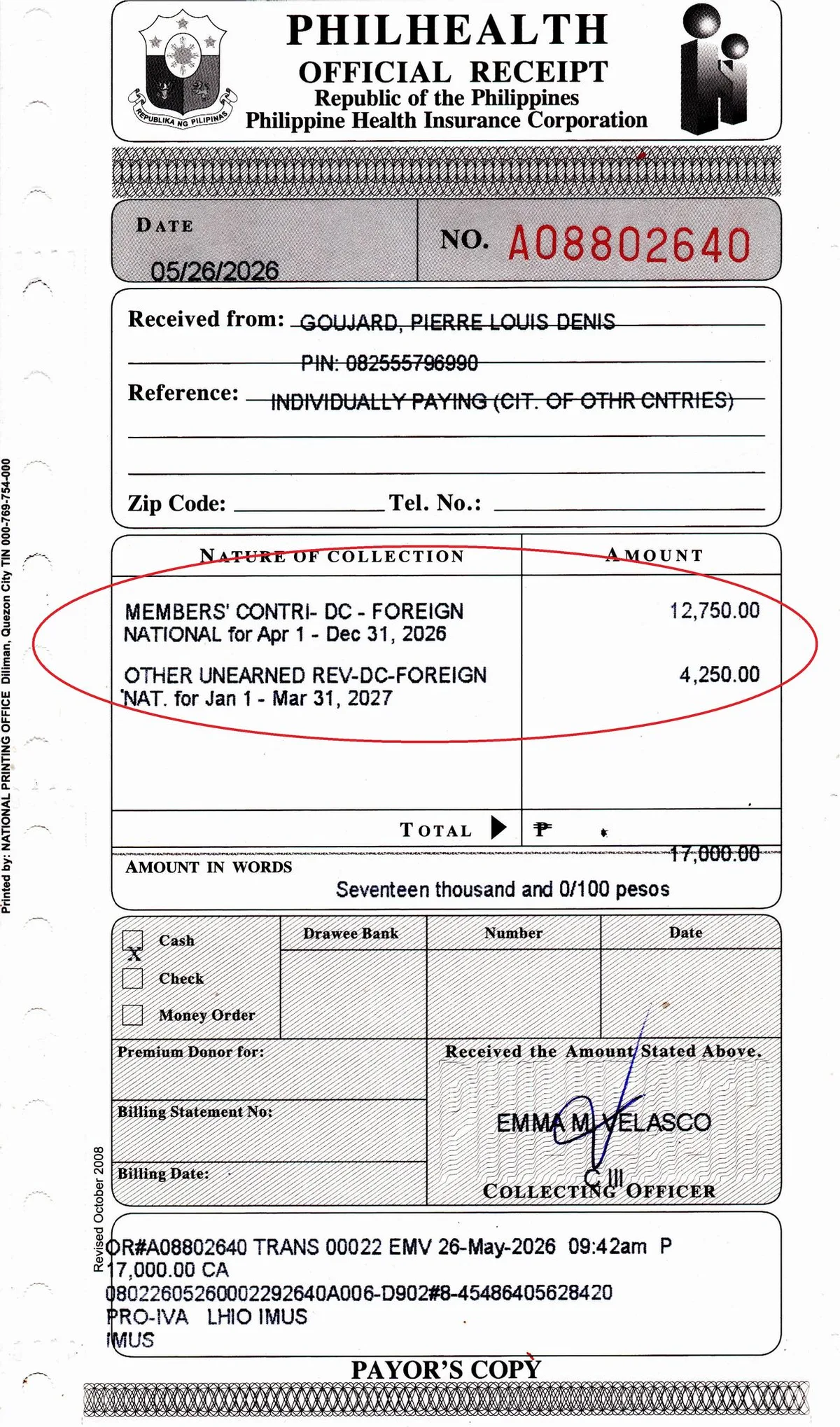
First, who can enroll in PhilHealth: foreigners with a valid ACR card and PRA retirees with an SRRV. The former pay 17,000 pesos a year, the latter 15,000 pesos a year, calculated on the calendar year. For example, if you pay 17,000 in November, you are only paying for the remainder of 2026, and on January 1 you pay another 17,000 for 2027. They accept cash only, and you need to bring a 1x1 photo. The simple form takes about 30 seconds to fill out, and at the counter the whole process takes 3 to 5 minutes. When you enroll, you will be asked where you want your Yaman ng Kalusugan Program (YAKAP) benefit assigned. YAKAP replaced the old Konsulta program. It is an outpatient benefit that includes free consultations and checkups, free lab and diagnostic tests, free cancer screening (including colonoscopy and mammography), and free maintenance medications (up to 20,000 pesos a year, with a long list that includes blood pressure, diabetes, and asthma medications). YAKAP works throughout the Philippines, but not every hospital that accepts PhilHealth has a YAKAP contract. Even if you like a hospital that accepts PhilHealth for inpatient care, don't assume it's a YAKAP partner. Check. YAKAP isn't only at hospitals; many outpatient clinics are partners too. For example, here in Cebu City, Healthway at Ayala Mall is a YAKAP contractor. It has doctors, lab, X-ray, and a pharmacy, so you can use most YAKAP benefits there. Or, also in Cebu, you can be assigned to Maayo Hospital, as I was. Maayo is the most modern hospital here and the closest to Western standards. Thanks to PhilHealth, my colonoscopy was covered 100% there, saving me about 20,000 pesos on that alone. So even if you have no plans to use inpatient care, the outpatient benefits alone can pay for themselves. The key point is that you can change your YAKAP facility only once a year. Ask for a printout showing your YAKAP selection. That document is your "ID" (proof) when you need it.
For inpatient care, it's true that coverage is usually not 100%. But if you truly have no money, PhilHealth can give you "zero balance–zero bill" coverage. For example, suppose you need hernia surgery. Ask the surgeon whether they have privileges at a public hospital. If you are admitted under PhilHealth, agree to a ward room, and have the surgery, you pay nothing. If they say no ward beds are available, they must free of charge give you a semi-private room. Most (though not all) private hospitals have a similar arrangement: after a meeting with a social worker, they can classify you as "charity," and any amount PhilHealth doesn't cover can be handled through a promissory note when you're discharged. In a ward or semi-private room, no one can keep you from leaving because of money. As with everything I say, look up the current rules and official circulars yourself. Unfortunately, what actually happens in practice can be different, so keep your documentation on hand. I've pulled out my phone and shown the rule text several times, and I've won.
One more point about acute inpatient care. If you have PhilHealth and another insurance (I recommend Pacific Cross), use PhilHealth first and then the other insurance. That way you use less of your annual limit (ABL). Make sure your insurer has someone on your side to help. With Pacific Cross, that's Michael Onstad. He and his staff are excellent at helping with admissions, discharges, and claims.
The Z package benefits. There is a false rumor going around that PhilHealth covers no "catastrophic" illnesses for foreigners. That isn't true, and it usually comes from confusing it with the Z benefit. It's true that the Z benefit is a package foreigners cannot use. Keep two things in mind. First, "catastrophic" (also called "major") illnesses are a very large category. The list of conditions recognized as catastrophic is nearly endless. Second, the list of major illnesses under the Z benefit that foreigners cannot use is relatively short! Perhaps half of it concerns pediatrics and women's health. I'd estimate that more than 95% of major illnesses are not on that Z list. What is not covered: breast, cervical, and prostate cancer; heart valve surgery; CABG (coronary artery bypass); kidney transplants; the actual implant in hip replacement (the surgery itself is covered); and rare genetic diseases.
Hemodialysis. Coverage increased significantly last year, to 156 sessions per calendar year. This is not on the Z package list.
Outpatient procedures and same-day surgery. Make sure what you need is covered. Download the PhilHealth ACR Search app! If a doctor recommends something (in my case, an elbow injection), tell the doctor you want to use PhilHealth and ask for the ICD-10 and RVS codes. Enter both into the app and it will tell you exactly how much PhilHealth covers. Some places bill only that amount. Some add a little. In my experience, I paid nothing.
So, that's a rough overview. Of course, I haven't covered everything or every situation. My point was to share some information that may help and to show that PhilHealth is not a useless "discount card." People who say that are just advertising how little they know.
If you have questions, feel free to PM me. I've also been interviewed about healthcare on a few YouTube channels, including Chad Foster Explores and Amazing Philippines. I recently did one with Filipina Pea as well, and I hope it goes up soon.
This is really helpful! Thank you 🙏 Would it be okay if I make this into a PDF and upload it to the group's files section?
Important correction. PhilHealth operates on a calendar-year basis, but if you pay 17,000 or 15,000 pesos at any point during the year, that amount gets split between this year and the next. See the photo of my last receipt.
Good post. My problem is with the enrollment itself. I was turned down because I'm not a permanent resident. I have an ACR-I card and I rent a house, but I'm still on a 9a tourist visa. At PhilHealth I was told they would accept me, but when I tried to enroll, I was rejected. I wonder if going to a different office will make a difference, like with many other government procedures in the Philippines. About 40% of the medicine I take is on that list, so being able to enroll would be a big help. I'm planning to get married next year, so the issue should be resolved once I'm on a 13a visa.
Good post! I'm new here and still learning. Could you tell me one thing? Is the 17,000 an annual deductible, or is it the amount you pay over the year? And is it in pesos or dollars? Thanks!



Comments 0
Please log into write a comment.